
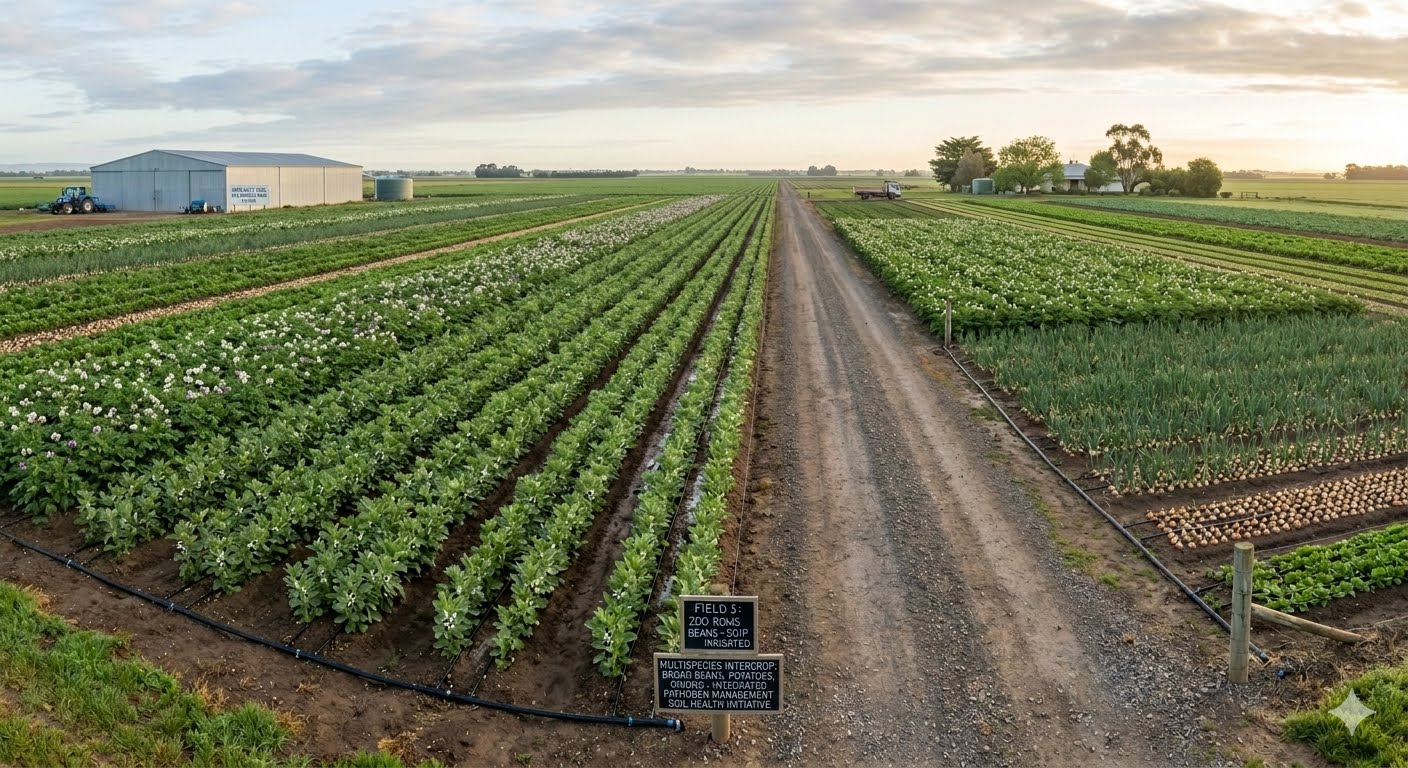
Winter Intercropping with Potatoes, Fava Beans and Onions: A Profitable Opportunity Hidden in Plain Sight
When most farmers think about winter crops, potatoes often come to mind first. Potatoes are a proven staple crop with strong market demand, good storage characteristics, and excellent returns when managed correctly. However, what many farmers overlook is the opportunity to increase profitability, improve soil health, and diversify income by integrating companion crops into their potato production systems.
This winter, I am exploring an intercropping system that combines potatoes, onions, and fava beans (also known as broad beans). What surprised me during my research was discovering that fava beans are the third most cultivated legume crop in the world. Despite their global importance, they remain largely underutilised in South Africa, creating an opportunity not only for food production but also for seed production and export.
Why Intercrop?
Intercropping is the practice of growing multiple crops in the same area simultaneously. The objective is simple: maximise the productivity of every square metre while reducing risk and improving soil health.
A well-designed potato, onion, and fava bean system offers several advantages:
- Improved land utilisation
- Reduced weed pressure
- Better soil structure
- Increased biodiversity
- Multiple income streams from the same field
- Improved resilience against market fluctuations
Instead of relying on a single crop, the farmer can harvest potatoes, onions, and broad beans from the same production area.
Potatoes: The Foundation Crop
Potatoes remain one of the most versatile crops a farmer can grow. Under good management, potatoes produce excellent yields and can be stored for extended periods.
Potatoes benefit from:
- Deep, fertile soil
- Consistent moisture
- High organic matter
- Well-managed fertility programs
In our system, potatoes are planted into soil that has been heavily amended with compost. Hay is used as a mulch to reduce evaporation, suppress weeds, and protect the soil from winter temperature fluctuations.
This approach builds soil rather than mining it.
Onions: A Natural Companion Crop
Onions are excellent companion plants because they occupy a different rooting zone and have different nutrient requirements than potatoes.
Benefits of integrating onions include:
- Additional income per hectare
- Efficient use of available space
- Natural pest suppression
- Improved cash flow
Because onions can tolerate cooler winter temperatures, they fit naturally into a winter production program.
Fava Beans: The Hidden Opportunity
The real surprise in this system is the broad bean.
Many farmers are familiar with soybeans, dry beans, and peas, but few realise the global importance of fava beans.
Fava beans are:
- One of the oldest cultivated crops in the world
- The third most farmed legume globally
- Highly valued for both human and animal consumption
- Rich in protein
- Excellent nitrogen fixers
As legumes, fava beans work with beneficial bacteria to capture nitrogen from the atmosphere and make it available in the soil.
This creates a natural fertility system that benefits surrounding crops and reduces fertiliser requirements.
Building Soil While Growing Food
One of the biggest advantages of including broad beans in a potato system is the improvement in soil fertility.
Modern agriculture often relies heavily on synthetic fertilisers. While these fertilisers can increase yields, they do little to improve long-term soil health.
Broad beans contribute:
- Nitrogen fixation
- Organic matter
- Improved soil structure
- Increased microbial activity
Instead of viewing fertiliser as an input cost, broad beans allow farmers to grow part of their fertility program directly in the field.
The Seed Production Opportunity
While broad beans are valuable as a food crop, I believe the bigger opportunity may lie in seed production.
Most South African farmers have limited access to locally produced broad bean seed.
This creates an opportunity to:
- Produce certified seed
- Supply local farmers
- Supply vegetable growers
- Supply regenerative agriculture projects
- Supply export markets
As awareness of regenerative farming practices grows, demand for nitrogen-fixing crops is likely to increase.
The farmer who establishes seed production capacity early may enjoy significant first-mover advantages.
Exploring Export Markets
International demand for broad beans continues to grow.
Major importing regions include:
- Middle East
- North Africa
- Europe
- Asia
Broad beans are used for:
- Human consumption
- Livestock feed
- Plant protein production
- Food processing
Export opportunities exist not only for the beans themselves but potentially for seed stock and specialised varieties adapted to different environments.
Before entering export markets, farmers should focus on:
- Consistent quality
- Reliable production
- Seed purity
- Traceability
- Strong relationships with buyers
A Winter Farming System with Multiple Revenue Streams
A farmer implementing this system can potentially generate income from:
- Potatoes
- Onions
- Broad beans
- Broad bean seed
- Future export opportunities
This diversification reduces risk dramatically.
If potato prices are weak, onions may perform well.
If onion prices decline, broad beans may carry the season.
If all three perform well, the farm benefits from multiple profitable harvests from the same area.
Looking Ahead
The future of farming belongs to producers who think beyond single-crop systems. Intercropping potatoes, onions, and broad beans offers a practical pathway toward healthier soils, lower input costs, and more resilient farm businesses.
The discovery that broad beans are the third most cultivated legume crop globally highlights just how much opportunity exists in crops that are often overlooked.
For my own operation, I see broad beans as more than just a companion crop. I see them as a potential seed business, an export opportunity, and a tool for building soil fertility naturally.
By combining potatoes, onions, compost, hay mulch, and broad beans into a single winter production system, we can create a farming model that is productive, sustainable, and profitable.
The opportunity is not simply to grow food. The opportunity is to build a complete agricultural value chain around crops that improve the land while generating income.
Word Count: 1,012
Tags:
Leave a Reply